Home › Asphalt Pathways, Sidewalks, and Trails
Precision Asphalt St Louis installs asphalt pathway paving in St Louis, MO for sidewalks, greenway trails, and bike paths. We create smooth, accessible routes through parks, campuses, and commercial sites with proper widths, gentle slopes, and durable surfaces for walkers and cyclists.
Precision Asphalt St. Louis provides professional asphalt pathway paving throughout St Louis, MO, Missouri and the surrounding area. Our licensed, insured crew delivers safe, clean, on-time work with a free estimate before anything begins. Call (314) 333-7779 or request your free quote.
Asphalt Pathways, Sidewalks, and Trails in St. Louis
Asphalt pathways, sidewalks, and trails need to match how people actually move through a property, not just look good on a site plan. Precision Asphalt St. Louis focuses on practical layouts that handle daily foot traffic, bikes, strollers, carts, and light service vehicles where needed.
In the St. Louis area, freeze-thaw cycles, clay-heavy soils, and tree root growth are the main reasons asphalt walkways fail early. We design each pathway or trail thickness, base depth, and edge treatment to fit the real conditions at your site. A school walking path needs different specs than a municipal greenway or a narrow sidewalk along a parking lot.
Our team handles projects for HOAs, commercial sites, municipalities, parks departments, churches, apartment complexes, and private landowners. Whether you need a short connector sidewalk from a parking lot to a storefront or a longer recreational loop trail, we size the job correctly so you do not overpay for structure you do not need, and you do not underbuild and face early failures.
Planning and Design: Layout, Grades, and Local Codes
Before any asphalt is placed, we walk the site with you to understand how the pathway or sidewalk will be used. We look at traffic patterns, slopes, drainage routes, existing concrete or asphalt tie-ins, and where snow will be pushed in winter. In St. Louis, we also factor in regular salting and plowing on commercial sidewalks, which affects mix selection and thickness.
We measure grades to make sure slopes are comfortable to walk and meet ADA accessibility where required. This typically means limiting slopes to 5 percent for runs and 2 percent for cross slopes, unless your site is already steeper and a variance or alternative route is used. For multi-use trails, we consider bike speeds and sight lines at curves, especially near crossings or drive lanes.
Local municipalities and St. Louis County have specific standards for public walkways and park trails. Precision Asphalt St. Louis is familiar with these, including minimum widths, base material requirements, and edge conditions. For HOA or private projects, we explain which standards are worth following so you get durability without unnecessary cost.
At this stage we also talk about width. A simple residential sidewalk might be 4 to 5 feet wide, while a two-direction bike and pedestrian trail is often 8 to 12 feet. Wider paths cost more, but in busy areas they prevent shoulder damage and rutting from people stepping off the edge.
How Asphalt Pathway Paving Is Actually Built
Once the layout is set, we mark and saw cut where needed, then excavate to the proper depth. In most St. Louis soils, we dig 6 to 10 inches below finished grade for pathways, more where heavy utility or maintenance vehicles might drive. Soft or pumping subgrade gets undercut and replaced, or we stabilize it with aggregate so it will not move when it freezes or gets saturated.
We install a compacted aggregate base, usually 4 to 8 inches of limestone base rock for standard pathways and sidewalks. In shaded and wet areas like along creeks or low spots in parks, we often recommend a thicker base or a different gradation to keep the path from heaving and settling. Every lift of stone is compacted with rollers or plate compactors, not just the top, so you do not get future dips.
For asphalt, we commonly use a finer surface mix than parking lots so the finish is smoother for walking, wheelchairs, and bikes. Typical compacted asphalt thickness for a pedestrian-only path is 2 to 3 inches over the base. Multi-use trails or paths that will see maintenance vehicles often get 3 to 4 inches, sometimes installed in two lifts for better density.
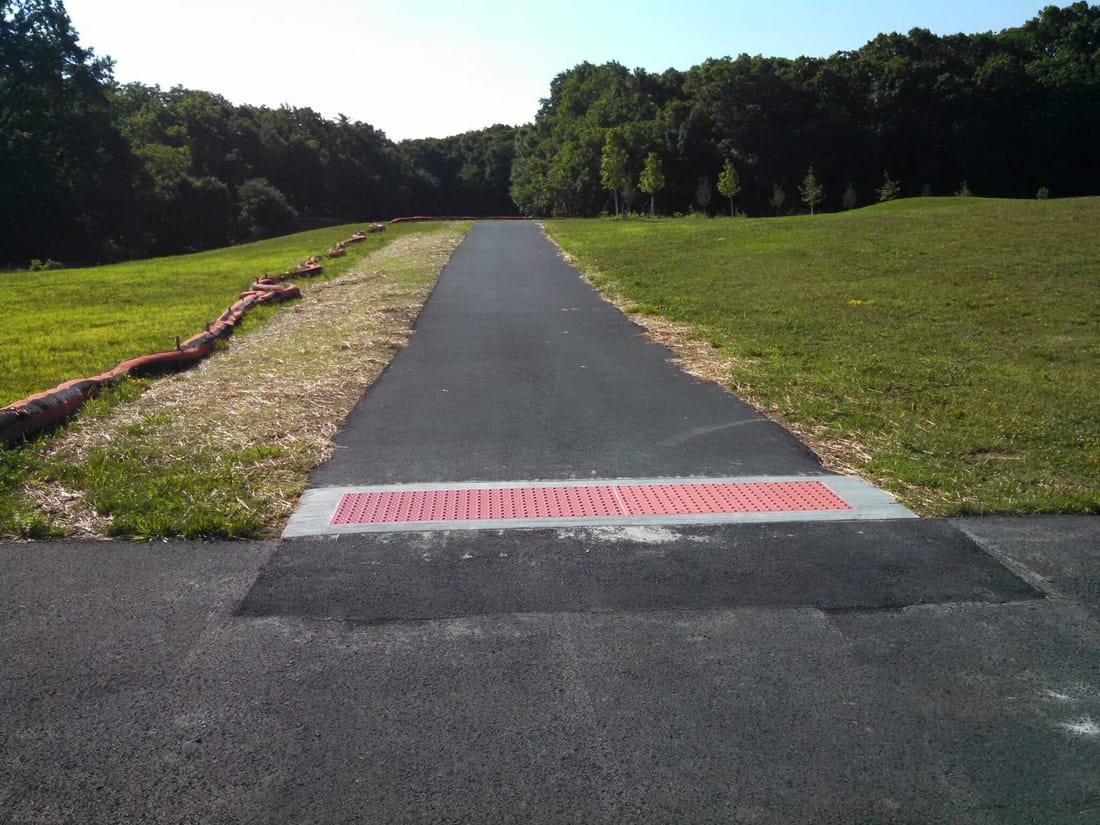
We match to existing asphalt or concrete at tie-in points so there are no trip lips. Edges can be left as compacted shoulder, backed with topsoil and seed, or contained with concrete, landscape curbing, or flush concrete bands depending on use and appearance requirements. For long linear trails, we schedule paving to control joints and transitions so there are no abrupt bumps between passes.
Material Choices, Durability, and Common Problems
For pathways and sidewalks in St. Louis, material selection is about finding the balance between cost and performance. Finer asphalt surface mixes provide smoother finishes, but in areas with heavy tree cover and constant root pressure, we may choose mixes that resist cracking a bit better even if the texture is slightly coarser.
Tree roots are a major issue for paths and sidewalks in older St. Louis neighborhoods and established parks. Precision Asphalt St. Louis identifies root zones in the planning stage and can adjust the route, switch to a root barrier system in targeted sections, or thicken the base and pavement to bridge minor root growth. When we reconstruct existing paths, we remove heaved sections, address the aggressive roots, and reinstate the base instead of just overlaying the problem.
Drainage is another common failure point. Water that stands along the edge of a path or crosses it constantly in one spot will weaken the base and lead to alligator cracking and potholes. We shape the subgrade and base to shed water, add swales or drainage outlets where needed, and may recommend small culverts or underdrains in known wet zones.
Salt use on commercial sidewalks and some trails accelerates surface wear. For areas that must be de-iced regularly, we specify mixes and thicknesses that can handle repeated freeze-thaw and chemical exposure. We also talk about realistic plowing methods so the path does not get scarred or rutted by equipment.
Costs, Scheduling, and What Affects Your Price
Costs for asphalt pathway paving in St. Louis vary mostly based on excavation depth, base thickness, access for equipment, and total length and width. Long, straight runs in open parks are the most cost-efficient. Small, chopped-up areas around buildings, tight courtyards, and projects that require a lot of handwork or wheelbarrowing are more labor intensive.
Site prep is often the biggest variable. If we are replacing an existing gravel path that already has a solid base, costs will be lower than starting from grass or wooded ground that needs full excavation and haul-off. Poor soils, such as deep soft clay or fill, can require stabilization or thicker sections, which we explain and price before starting.
Permits and inspections may be needed for public sidewalks, street-adjacent paths, and municipal or county trails. Precision Asphalt St. Louis can coordinate with local inspectors so your project passes the first time. Lead times in peak season can be a few weeks, but smaller pathway and sidewalk jobs can often be grouped with nearby work to keep costs down.
We provide itemized proposals that show separate pricing for excavation, base installation, asphalt paving, and any extras like concrete aprons, ramps, or striping for shared-use paths. This lets you see where adjustments can be made if you are working within a fixed budget, such as phasing a longer trail in sections.
Maintenance, Repairs, and When to Call Us
A properly built asphalt sidewalk or trail in the St. Louis climate should last many years with basic care. Routine sweeping keeps grit from grinding into the surface. Clearing leaves and organic debris helps prevent moss and algae growth in shaded sections, which can make the surface slick.
For multi-use trails or commercial walkways, we often recommend a sealcoat at the right time in the life cycle, usually after the pavement has fully cured and before the first signs of oxidation and hairline cracking spread. Sealcoating on pathways is not about making it black, it is about slowing moisture and UV damage.
Crack sealing is important on longer trails and large sidewalk systems. Addressing small cracks early prevents water from reaching the base and avoids the need for full-depth patching later. If you see areas where the surface is pumping fines or soft underfoot, that is a sign the base has been compromised and needs attention before a larger failure occurs.
Precision Asphalt St. Louis can inspect existing asphalt pathways, sidewalks, and trails, then give you a prioritized plan: what needs immediate repair to eliminate hazards, what can be maintained, and where it makes more sense to reconstruct rather than keep patching. We keep the explanations straightforward so you can make decisions based on condition, budget, and how the path or trail is actually used.