Home › Industrial and Heavy-Duty Asphalt Paving
Precision Asphalt St Louis provides industrial asphalt paving in St Louis, MO for truck yards, loading docks, and heavy equipment areas. We design thicker sections, stronger bases, and reinforced loading zones to handle demanding industrial traffic without premature rutting or failure.
Precision Asphalt St. Louis provides professional industrial asphalt paving throughout St Louis, MO, Missouri and the surrounding area. Our licensed, insured crew delivers safe, clean, on-time work with a free estimate before anything begins. Call (314) 333-7779 or request your free quote.
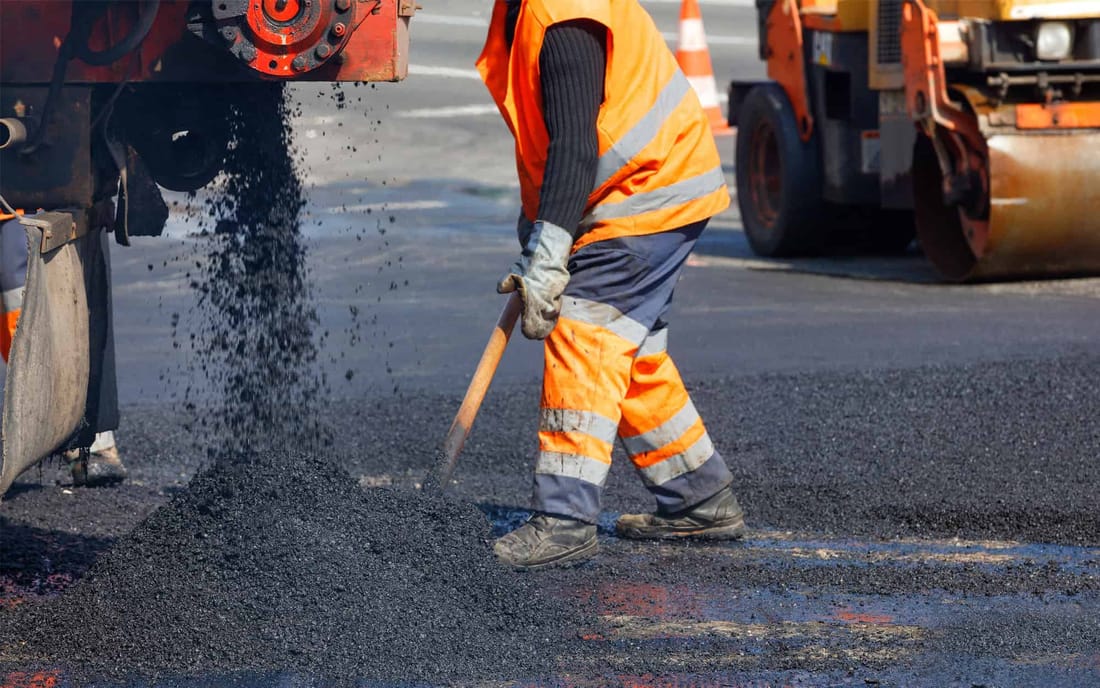
Industrial Asphalt Paving for St Louis Plants, Yards, and Terminals
Industrial asphalt paving is different from a basic parking lot. At Precision Asphalt St. Louis, we design and build pavements that hold up to forklifts, loaded semis, container stacks, fuel deliveries, and constant turning traffic. Most of our industrial work in the St Louis area is for manufacturers along the I-55, I-44, and I-270 corridors, distribution yards in the Riverport and Earth City areas, and older industrial sites in the city that were never engineered for today’s traffic loads.
Before we talk about paving, we start with how you actually use the site. We will ask what equipment runs on the pavement, axle loads, turning patterns, chemical exposure (like oils, solvents, salt, or fuel), and how often you plow or salt in the winter. A food processor in north St Louis, for example, needs different asphalt properties around loading docks than a scrap yard near the river that uses heavy loaders and cranes.
We also look at existing conditions. Many industrial properties in St Louis were paved decades ago over fill, cinders, or poorly compacted soil. We core sample the existing pavement when needed, check asphalt thickness, and probe the base and subgrade to see what is actually under there. This is how we decide whether we can mill and overlay or if a full-depth reconstruction is smarter and safer long term.
Industrial asphalt paving is not about a pretty black surface. It is about a pavement system that matches your operations, soil conditions along the Mississippi and Missouri River basins, drainage patterns, and budget. Our role is to turn those variables into a plan that you can understand in plain terms, with clear options and tradeoffs.
How Industrial and Heavy-Duty Asphalt Paving Is Built
For heavy-duty work, we approach the project as a layered structure, not just a single lift of asphalt. A typical build for a truck court or plant yard starts with subgrade preparation. We strip soft topsoil, scarify and recompact the native clay, and undercut any pumping or saturated areas. In some pockets of south St Louis County and the river bottoms, soils hold water, so we often use stabilization fabric or lime treatment to keep the subgrade firm.
Next comes the aggregate base. For industrial asphalt paving we usually recommend 6 to 12 inches of compacted rock, depending on your loads and drainage. We place this in lifts, typically 3 to 4 inches thick, compact each lift with vibratory rollers, and proof-roll with a fully loaded truck so you can see exactly where soft spots show up before asphalt goes down.
On top of the base, we install multiple asphalt lifts. For heavy truck traffic, we often use a 2 to 3 inch binder course with a larger aggregate for strength, then a 1.5 to 2 inch surface course with a tighter, more fuel-resistant mix. Around fueling areas and high-shear zones, we may recommend polymer-modified mixes that resist rutting and shoving. Where forklifts pivot in place, we sometimes increase the surface thickness or tighten the joint layout to control cracking.
Every joint and transition is deliberate. We saw cut at dock doors and building entrances, tie into existing pavement with milled tapers, and adjust slopes to keep water away from slab edges and dock pits. After paving, we compact with multiple roller passes, checking density so the mat is tight and resists fuel and water penetration. For larger plants, we will often phase paving to keep your docks or access lanes open, coordinating windows with your shipping and production schedules so you are not shutting down operations just for paving work.
Cost Drivers, Bids, and Getting Realistic Industrial Budgets
Industrial asphalt paving costs in St Louis vary widely because no two facilities use their pavement the same way. Precision Asphalt St. Louis gives line-item proposals so you can see exactly what you are paying for. The biggest cost drivers are existing base condition, total section thickness, access and phasing, and drainage improvements.
If your existing pavement is failing because the base was never built for heavy trucks, trying to save it with a thin overlay usually leads to rutting and reflective cracking in a few years. In those cases, full-depth reclamation or removal and replacement costs more at the start but often wins over the life of the pavement. On the other hand, if cores show a solid base and enough existing asphalt, we can mill 1.5 to 2 inches and place a heavy-duty surface mix. That keeps trucks running, shortens downtime, and trims cost.
Traffic loading is another big factor. A staging yard that only sees occasional tractor trailers can often use a slightly thinner section than a constant-use loading dock with tight turning movements. We use equivalent single axle load (ESAL) concepts in the background, but we translate that into simple options, such as, "Option A: 8 inches of rock and 4 inches of asphalt," versus "Option B: 10 inches of rock and 5 inches of asphalt," with pros and cons for each.
Winter and stormwater also matter. Many older St Louis plants have almost flat yards and undersized drains. Adding structural pavement without addressing ponding can shorten pavement life and create ice hazards. We may propose adding inlets, installing shallow swales, or regrading to get at least a 1 percent slope toward drains. These items add cost up front but reduce freeze-thaw damage and safety risks long term.
When you request a quote, it helps to share any geotechnical reports, old plans, or known problem spots, like where trucks always bog down or where water constantly stands. This lets us tighten up quantities and contingency, so your budget reflects reality instead of guesses.
Common Industrial Pavement Problems in St Louis and How We Fix Them
Across St Louis industrial properties, we see the same failure patterns: rutting in truck lanes at plant entrances, cracking at dock approaches, settlement over unknown utilities, and surface breakdown where oils or chemicals spill. Precision Asphalt St. Louis designs repairs that address the cause, not just the symptom.
For rutting in heavy wheel paths, especially at stop signs or scale approaches, the problem is usually a combination of insufficient asphalt thickness and a base that was not compacted for modern truck volumes. To fix this, we often mill deeper in those lanes, undercut soft base, replace with compacted rock, and install thicker binder and surface lifts with a stiffer mix. That way, the entire wheel path is rebuilt to handle concentrated loads.
At loading docks, the concentrated weight at trailer landing gear can punch into pavement. To prevent this, we may recommend reinforced concrete pads at the dock face, tied into heavy-duty asphalt approaches. This hybrid approach costs more than all asphalt in a small area, but it dramatically reduces recurring damage. We pay close attention to the asphalt-to-concrete joint so it does not ravel or trap water.
Where we see spider cracking and potholes around catch basins or manholes, it is often a drainage or utility support issue. Our crews will excavate around the structure, rebuild the base, reset frames to the proper height, and repave with careful compaction around the rings to avoid future settling. In older city industrial districts, we often uncover layers of old brick, cinders, and debris under the asphalt, so plan on some contingencies when you are budgeting repairs.
For facilities with chemical or fuel exposure, we can recommend sealers and specific surface mixes that are more resistant to softening. On routes that require frequent snow plowing, we plan joint layouts and elevation transitions that are less likely to catch plow blades, and we advise you on plow shoe settings to avoid premature surface damage.
What to Expect When You Work With Precision Asphalt St. Louis
Industrial and heavy-duty asphalt projects live or die on planning. When you contact Precision Asphalt St. Louis, we start with a site walk at your plant, yard, or terminal. We listen to operations and safety staff, walk the truck routes, note trailer swing areas, and identify critical access points that must remain open. If your site handles rail, barge, or timed production shifts, we factor those windows into our phasing plan.
Next, we outline one or more pavement designs that match your load conditions and budget. For larger or more complex projects, we can work directly with your engineer or bring in a local geotechnical consultant for soils and thickness recommendations. We explain the plan in straightforward terms so your maintenance team, management, and safety staff are all on the same page.
During construction, communication is constant. You get a single point of contact who coordinates start times, lane closures, and any schedule shifts due to weather. Our crews are used to working around active operations in St Louis, so we set up clear traffic control, signage, and flagging where needed, and we sequence work so that docks and critical drive lanes are returned to service as soon as the asphalt has cooled and compacted adequately.
After paving, we provide care and maintenance recommendations tailored to your facility. This may include suggested turning radius restrictions until the pavement has fully cooled, timing of any line striping or wheel stops, and a long-term plan for crack sealing and periodic overlays to extend life. If you want, we can walk your site annually to spot early issues before they turn into major structural failures.
The goal is not just to install new asphalt, but to give you a heavy-duty pavement system that supports your operations, reduces downtime, and holds up to the realities of St Louis weather, soils, and traffic.